Showing posts with label Fiesta. Show all posts

Tuesday, November 1, 2011

…El Día de los Muertos 2011


Halloween came and went, but that's never the end of the craziness for me.  

As a Spanish teacher, I have to acknowledge the celebration of “El Día de los Muertos”, or “The Day of the Dead”.  Put simply, it is a Mexican holiday held on November 1st and 2nd to celebrate the spirits of those who have died.  Typically, November 1st celebrates the spirits of children who have died, and November 2nd is the day to celebrate the spirits of adults who have died. 

The Hispanic concept of death is quite different from our own here in the United States – death is celebrated, even played with, in the culture.  To los hispanos, death is not something to be feared - life lives on after death, and those who have died should be remembered and have their afterlives celebrated on El Día de los Muertos.  See http://www.peoplesguide.com/1pages/chapts/viva/dodead/bobbi/dodbobi.html for a more detailed explanation.

Many events take place to celebrate this holiday – people decorate ofrendas, or altars, in honor of their dead relatives, both in their homes and in cemeteries.  They put items on the ofrendas that will help to draw their spirits back – pictures, their favorite foods and personal items, pan de muerto (a sweet bread – see recipe here), cempazuchitl (yellow marigolds), candles, copal (incense), and skeletons and/or skulls to represent the person in the afterlife.

The skulls that are placed on the altar are typically made out of sugar and are known as “calaveras de azúcar”.  Decorating sugar skulls is a favorite activity of children and adults in Mexico (although they can be purchased for the altars as well).

It also tends to be a favorite activity of American students.

When I was student teaching back in, um, 2002, I bought sugar skull molds from Teacher’s Discovery, figuring that I would get a lot of use out of them.  I found a recipe online for making sugar skulls, and got to work practicing.

I have now mastered the art of making sugar skulls.

The recipe is as follows:

1 cup white sugar
1 tsp. cream of tartar (dried egg whites)
1 tsp. water

THAT’S IT.

I usually quadruple this and do it in batches.  It usually makes 8-10 sugar skulls, meaning that there is as much as ½ cup of sugar in each skull.  Every year, I tell the students this, and every year I recommend not eating the skulls because ½ cup of sugar is way more than anyone should consume in a week.

And every year, there are at least a few students who don’t listen.  Shocker.  Halloween candy + sugar skull = parent & teacher nightmare.

First, I add the ingredients to large bowl (in that order – sugar, cream of tartar, water) and mix it with my hands until it feels like wet sand.

Adding the cream of tartar to the sugar
I then press the sugar into the molds with my hands, and level off the back with a cake icer or leveler.

Leveling off the back of the mold
 Then, I take a bar-sized (small) cutting board loosely-but-still-firmly-covered (you’ll see why soon!) in foil and press it firmly to the back of the mold.  I carefully flip the mold over, so that the skulls are now lying flat on the cutting board.

Flat on the cutting board, still in the mold
 I then carefully lift the mold straight up, as not to disturb the still-fragile skull.

Success!
 I don’t have an unlimited amount of bar-sized cutting boards in my house – I only have one – so I need it back to do the next 2 skulls.  I carefully unfold the foil from the bottom and side edges of the cutting board, as necessary (hence the “loosely-but-still-firmly-covered” description), and carefully slide the cutting board out from below the foil while pulling the top of the foil in the opposite direction.  Believe me, it has taken YEARS to perfect this, but I rarely end up with broken (or cracked) skulls anymore.

TA-DA!  Sugar skulls!


 They should be left to dry for at LEAST 24-hours – I try to let them dry longer, if possible, especially if the weather is humid.  I also leave the ceiling fan on in my dining room to help with the drying process.

For our Spanish Club party for El Día de los Muertos, I brought in the sugar skulls for the students to decorate.  I have done this with my classes in the past, but this year, I didn’t have the money nor the time to make 168 skulls.  20 was manageable.

Undecorated sugar skull
 I also brought in icing to use to decorate the skulls.  Sugar skulls are typically NOT eaten, so they use non-edible decorations in addition to icing, such as colorful foil, plastic pieces, and glue.  Since I have students who don’t listen (and I don’t want to create a choking hazard), I stick to icing only.

I think that the students did a beautiful job!  Scroll down to see some of them, and keep scrolling for a little shocker...


Hopefully next year, time and money will permit more…

…Oh, yeah, the "little shocker" - I ate my first “walking taco” at the party – Fritos, taco meat, lettuce, tomato, cheese, salsa, and sour cream, all mixed together in a Frito bag.  Easy?  Yes.  Authentic?  NO WAY.  Perhaps that’s good enough for the kids, but not for this Reyna de Autenticidad…

*sigh* Not authentic

Friday, September 16, 2011

…Giant Eagle’s Latin Food Fiesta with BONUS The Pampered Chef Mango Wedger

This title sounds like a really bad infomercial, I know – but it needs to be said this way.

I was so excited when I read the tweet from @Giant_Eagle on Thursday that they were having a Latin Food Fiesta to celebrate Hispanic Heritage Month (September 15-October 15)!  I tweeted the link to the website with the info, which @Giant_Eagle then re-tweeted…ooh, I’m famous! 

Not really. 

I became skeptical, though, when I saw that there was a link to see WHERE this was being celebrated.  Uh oh.  I knew that the Kennywood Giant Eagle wouldn’t be on the list, but I held out hope for The Waterfront location.

They ARE!  AND they are the only Pennsylvania location holding it all 4 days – September 16, 17, 23, and 24!  AMAZING!  AND I do my grocery shopping on Fridays there anyway, so I could check it out!

It’s sad what gets me excited these days, I guess.

Later, I opened my Giant Eagle ad at home, which had arrived the day before – I probably should have looked at it sooner, but I was busy going to Mallorca for dinner the day before (more about that later).  They were advertising many Latin American brands that were on sale for the fiesta – Goya, La Preferida, etc. – brands that are widely sold at Giant Eagle, but can also be found at Reyna Foods in the Strip District.  I was excited to see what was going to be offered.

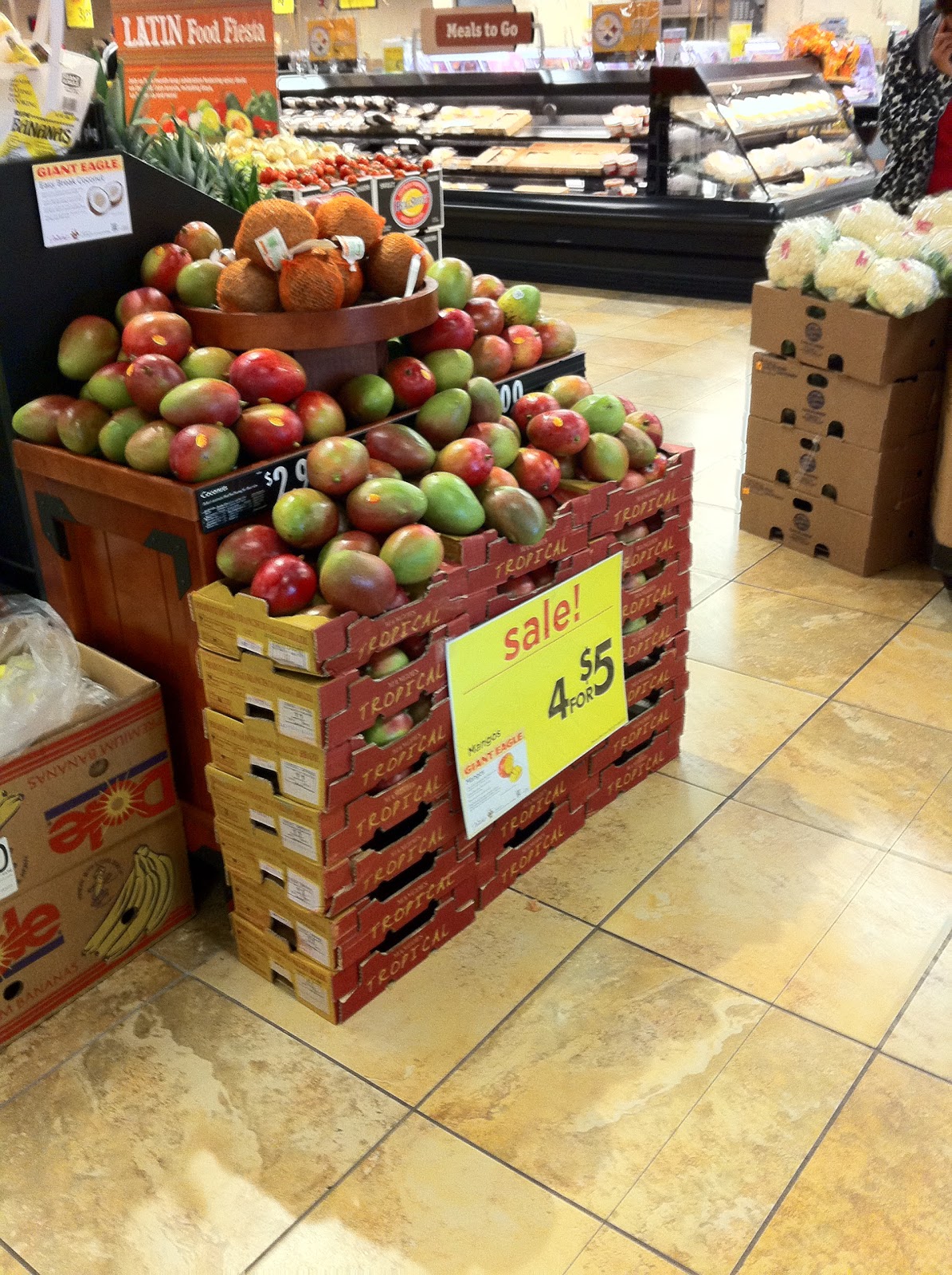
When I arrived at Giant Eagle on Friday afternoon, I went about my normal produce-buying routine – apples, bananas, kale…- and then came across these babies:


Ahhhh, mangoes.  I’ve said it before, and I’ll say it again – I love mangoes.  4 for $5?  SOLD.

Not far from the mangoes was a display for produce related to the Latin Food Fiesta celebration:


Ok, yeah, hot peppers, tomatillos, avocados, cilantro, limes, sweet onions, bell peppers…I get all of that.  Nothing too out of the ordinary or exciting, though.

I remembered seeing in the ad about rambutans, which I had never seen at Giant Eagle before – I had no idea what they were, but I did remember that they were $6.99/lb. in the ad.  That’s insane!  $6.99/lb.?  No way was I buying them.

I was tempted to buy them just because they looked interesting, but I didn’t, and not just because of the price.  I didn’t know what they were.  I don’t know what they taste like.  I still don’t.  Wait, let me Google it…

Well, you can read about it at http://www.rambutan.com.  It’s totally not related to anything Latin or Hispanic – but here’s a pic:


Here’s a tip, Giant Eagle – if you want me to buy something, educate me on it…and offer a sample.

Anyway, I continued through the produce section to buy ingredients for Pumpkin Chili (I’m super excited that it’s almost fall and appropriate to eat anything with pumpkin once again), and I came upon another section of exotic produce.


GUAVA!  I have been looking for guava for months!


Yucca root!  I LOVE the yucca fries from Chicken Latino!  Maybe I can try to make my own!


Ugh, really?  Hispanic Heritage Month, and jicama is STILL $3.99/lb.?!  At least now I know that I can buy it at Stan’s Market in the Strip District for $.89/lb.

I continued about my normal shopping routine, and the usual ladies were across from the meat section, offering samples, as usual – but today I noticed that everything that they were offering samples of was a Latin brand-product – some sort of Spanish rice, some Goya product…

Oh boy.  There was prepared mole.  I had to try it. 


The woman offering the sample said that it was a chicken enchilada with mole.  I told her that I love mole, and ate my sample.

Ick.  It was cold.  And it pretty much tasted like a commercial-brand flour tortilla, covered in mole, rolled up, and cut into small pieces.  Chicken enchilada?  Barely.

No sale.

I finished my grocery shopping, and went to the checkout.  The girl ringing up my purchases rudely asked me what my Yucca root was, as I guess that’s not a common purchase, so I left, packed up my car, and went home, disappointed that Giant Eagle’s Latin Food Fiesta did not set off the explosion in my heart quite the way that the word “fiesta” does on its own.

I’m glad that Giant Eagle is taking a step to make people aware of their Latin American products, but the execution could be better.  I know that the Shaler location is having a book signing by Aarón Sánchez from Food Network’s “Chefs vs. City” on the 17th, but that is not enough to make people aware of what Latin cooking is all about.  People need to be educated on the common flavors and ingredients, and how they come together to make Latin food taste as sabrosa y rica as it does.

After dinner at Chili’s (don’t judge me – I’ll explain more later), I came home to taste some of the unusual things that I had purchased earlier.

Well, first I had to get my pumpkin chili prepared and in the crockpot.  That was a priority.

I then took out my yucca root to take a pic for you all to see – and noticed something strange – one of the roots had split into two pieces, and a small piece had come off.  That’s weird.


Oh, that would be why – it was molding.  Fabulous.  $1.99/lb., and it’s moldy.  I had put two roots back while picking them out because they were moldy – I should have taken that as a sign that I shouldn’t buy it.

I then decided to taste the guava – I had bought those guava-flavored wafer cookies by Goya as part of the number challenge reward – they were amazing, by the way - and I had one student who came back for seconds…and thirds…and fourths…so I was curious to see what guava tasted like on its own (and not in wafer cookie form).


I took a spoon to the middle, figuring that was where the most flavor was – and I was right.  Unfortunately, there wasn’t much flavor at all.  I’m thinking that it wasn’t quite ripe enough, so I’ll let the other one sit for a day or two before I try it.

After those two depressing experiences, I needed a sure thing – ahhh, mango.  


I have to say, without a doubt, that The Pampered Chef Mango Wedger has made my mango-eating experiences much more enjoyable.  You may know (or maybe you don’t) that the skin of a mango is not edible (or tasty, for that matter), so only the yellow-orange fruity part should be consumed; however, the pit of a mango is oblong and hard, so getting the fruit by itself is not easy to do – unless you have this magical mango wedger.


With the help of my mango wedger, I have mastered the art of mango consumption.  I wedge the mango, and then cut each of the four sections in half.  This gives me eight sections of mango, plus any fruit left on the pit.  


I put it all in a bowl, and to eat the mango, I treat the skin as I would a cantaloupe or watermelon rind – I eat the fruit all the way down to it.  Mangoes are even better for this, too, because you can use your teeth to peel the fruit away from the skin, and then discard the skin.  I use a fork to scrape any fruity parts off of the pit, and eat that, being sure not to waste any good mango-y goodness.


So that was my Friday night – pumpkin chili in the slow cooker, moldy yucca root, tasteless guava…but ending with sweet, delicious mango.  Oh, and black tea.  Not important, but it was part of my night, and it was comforting.

I guess I should write about my dinner at Mallorca…and explain why I was at Chili’s, of all places, on Mexico’s Independence Day….

Giant Eagle – Waterfront Location
420 East Waterfront Drive
Homestead, PA 15120


If you are interested in The Pampered Chef Mango Wedger, please contact:

The Pampered Chef
Marie McDonald – Consultant

Sunday, July 31, 2011

Fiestas, Food, and The Epiphany


Fiesta.
There was a confetti explosion in your heart when you read that word.  “Fiesta” stirs up contentment, exhilaration, anticipation – we humans like parties, but LOVE fiestas. 
I know – a fiesta is a party, it’s just the fancy Spanish word for one.  Being a Spanish teacher, I know my Spanish vocabulary…but I also know that if you really want your party to sound Party-of-the-Year-worthy, you call it a fiesta. 
The most common question of my own Spanish teachers in school was not, “How do you conjugate this verb?” or “What does ______ mean?” or “How do you say _______ in Spanish?” – it was, of course,  “When are we going to have a fiesta?”  Fiesta day = Best day ever.
Of course, the only reason anyone wanted to have a fiesta was because of the food.  We had to bring food and materials in for our potluck feast, of course, but it also meant that we got to eat a plethora of foods that others had made.  Of course, the slackers (me NOT included, of course) were the ones who brought in plates, forks, pop (not soda – this is Pittsburgh, after all)…but the “real” students, as my one teacher referred to them (ok, us), brought in a recipe that they (we) had found and made themselves (ugh, ourselves).  Typically, it was something Mexican – tacos (or at least some ingredients for tacos – the shells, the lettuce, etc.), tortilla chips (store-bought – no one was ambitious enough ), salsa (the overachievers made it themselves, but typically store-bought), beans, etc.  One time, my teacher actually made fried ice cream right there in the Home Ec room (it didn’t have that fancy “Family and Consumer Science” title at that time). 
My views of the foods that Spanish-speakers ate were completely off when I visited Mérida, Mexico after my freshman year of college in 1999.  My professor warned me and the two other girls that I traveled with that what we were expecting to eat may not be what we actually eat.  Although that was 12 years ago, my thoughts of the food and smells of Mexico are still quite clear.  Basically, the air smells of corn tortillas no matter where you go.  The cheese is “queso blanco”, which doesn’t have a lot of taste, but goes well with the other flavors of Mexican food.  And given the not-so-adventurous nature that we had back then, Burger King was our savior pretty much every night.  Whoppers saved the day…and our starvation.
During my time in Mexico, we visited a family that my professor had befriended over many years.  They were very poor, and lived in a village called Hoctún, which, up until about a year previously, hadn’t even had running water.  They invited us to eat with them twice, and when a family with hardly a peso to pinch invites you to eat, you eat.  I watched them make corn tortillas from scratch.  We ate watermelon that was surrounded by flies at all times.  Chickens wandered in from the outside (there were no doors in the back, since it was an adobe), and…well…pooped on the floor next to us as we ate.  It was an unusual experience, and one that I remember clearly. 
I also remember the other night that we were invited to eat with them at their bakery.  The food was placed in front of me, and I couldn’t believe my eyes – spaghetti.  Really?  In Mexico?  Upon further inspection of the noodle-y concoction, there was some sort of mystery meat mixed in with the tomato sauce, so I asked my professor, “Is this ham?”  I can’t eat ham – my body can’t digest it properly, and being in Mexico and having eaten many other native foods throughout the week, my stomach was already in disarray.  She looked at it and said, “No, it can’t be.”  So I ate it. 
Guess what?  It was ham.  My body knew, and proved it.
Over the course of college and my Spanish-learning days, I came to find out that Mexican food was WAY, WAY different from the foods of other Spanish-speaking countries.  Unfortunately, I had to read about them in books, magazines, or newspapers, or see them on TV - I did not have the opportunity to experience these foods for myself, mainly because there was nowhere for me locally TO experience them. 
Until recently.
On June 23, 2011, I read an article in the “Food & Flavor” section of the Pittsburgh Post-Gazette entitled, “Latin-American influence gaining momentum in Pittsburgh restaurant scene”.  In the article, Smoke, a restaurant that had just opened in Homestead, no more than 10 minutes away from my humble abode, was mentioned.  I was as excited as if someone had said the word “fiesta”. 
I had to go. For some reason, one that I still cannot explain, I had to try it.  So I went the next day.
The verdict?
Heaven. 
This is how my epiphany began.  Details of the actual epiphany to follow.

Follow me on Twitter @senoritacibulka